

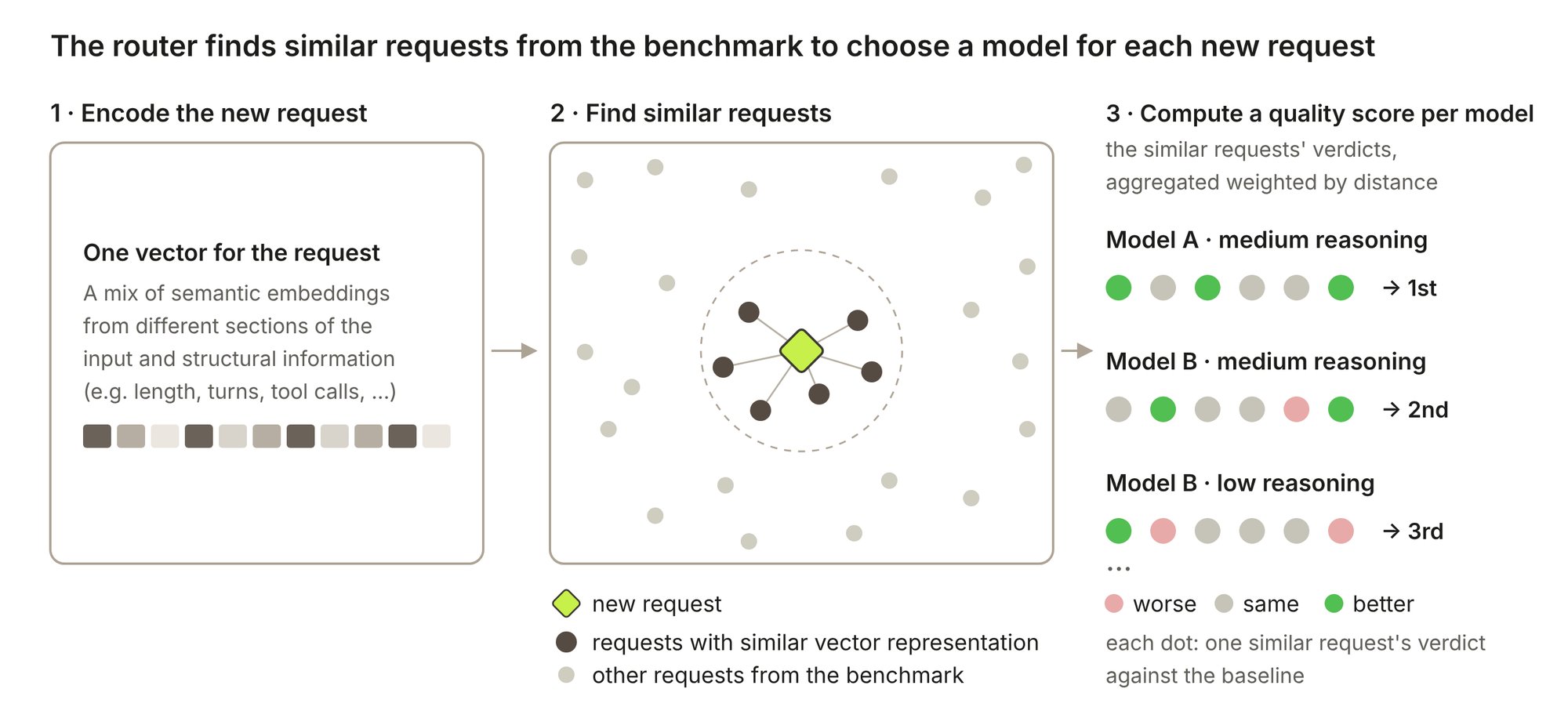
Finding similar calls
The router encodes each call from two kinds of signals:- Semantic: embeddings of what the call is about, such as its latest message or its tool definitions.
- Structural: the shape of the call, such as its length and its number of turns and tool calls.
Predicting each model’s quality against the baseline
For each candidate model, at each reasoning level, the router reads its verdicts on those similar calls, giving more weight to the calls closest to the incoming one. The result is a quality score per model: how likely its answer is to be as good as or better than your current model’s.Choosing which model to call
The router ranks the models by the objective of your routing strategy:- Best quality: the model with the highest quality score, the cheapest one on a tie.
- Same quality, lowest cost: the cheapest model whose quality score reaches your current model’s.
- Same cost, best quality: the best model at about your current model’s cost.
Next

Routing strategies
Pick the objective and the models in the dashboard.

Benchmarking
How the verdicts the router reads are produced.